European military space is now a programmed, multi-state build-out
Military space used to be the smallest and least legible segment of European defence procurement: a few national programmes, run through space agencies. That has changed. The capability build-out now under way is stated in advance, with the domain, the participating states, the financial ambition and the horizon all named.
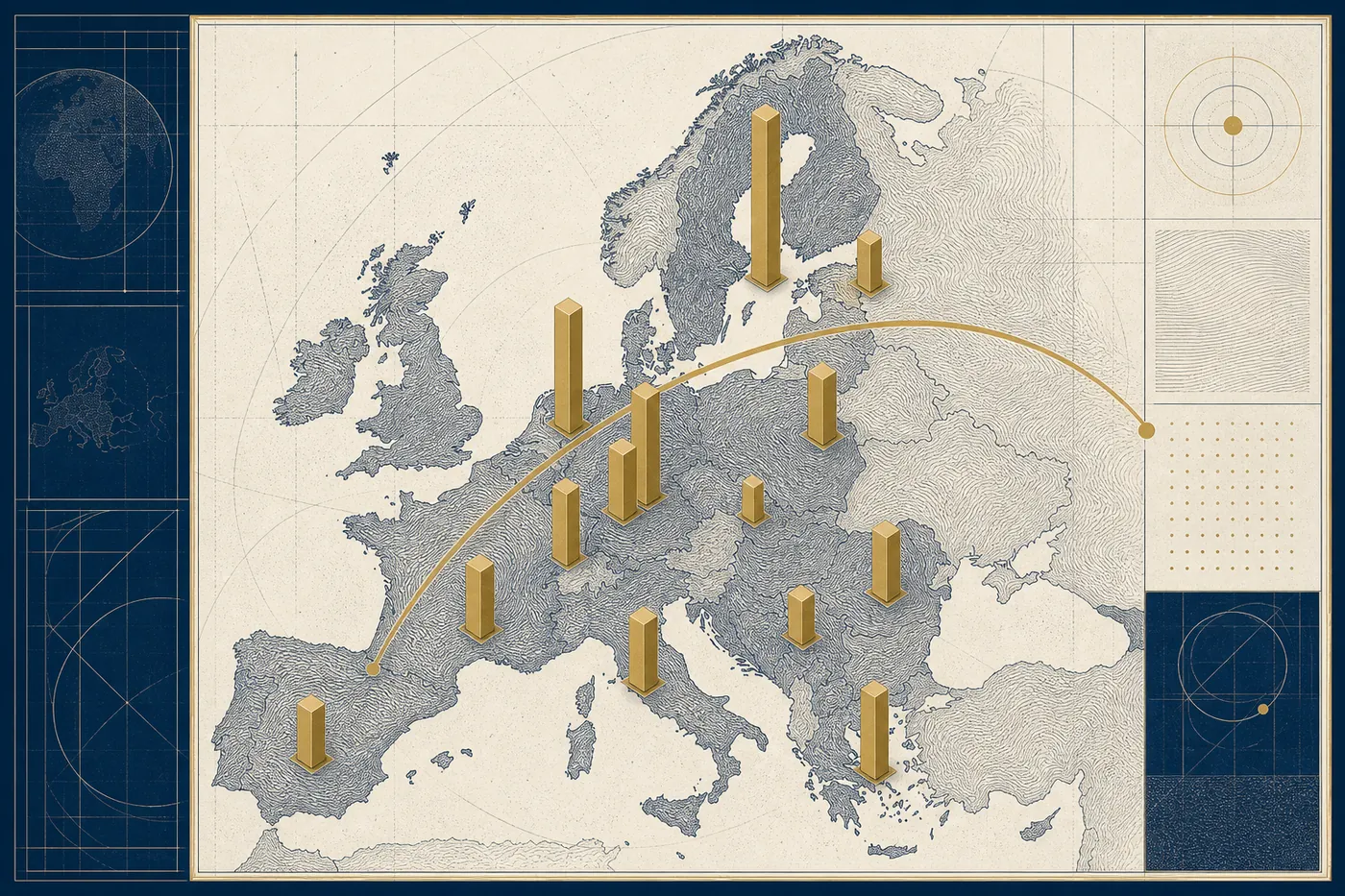
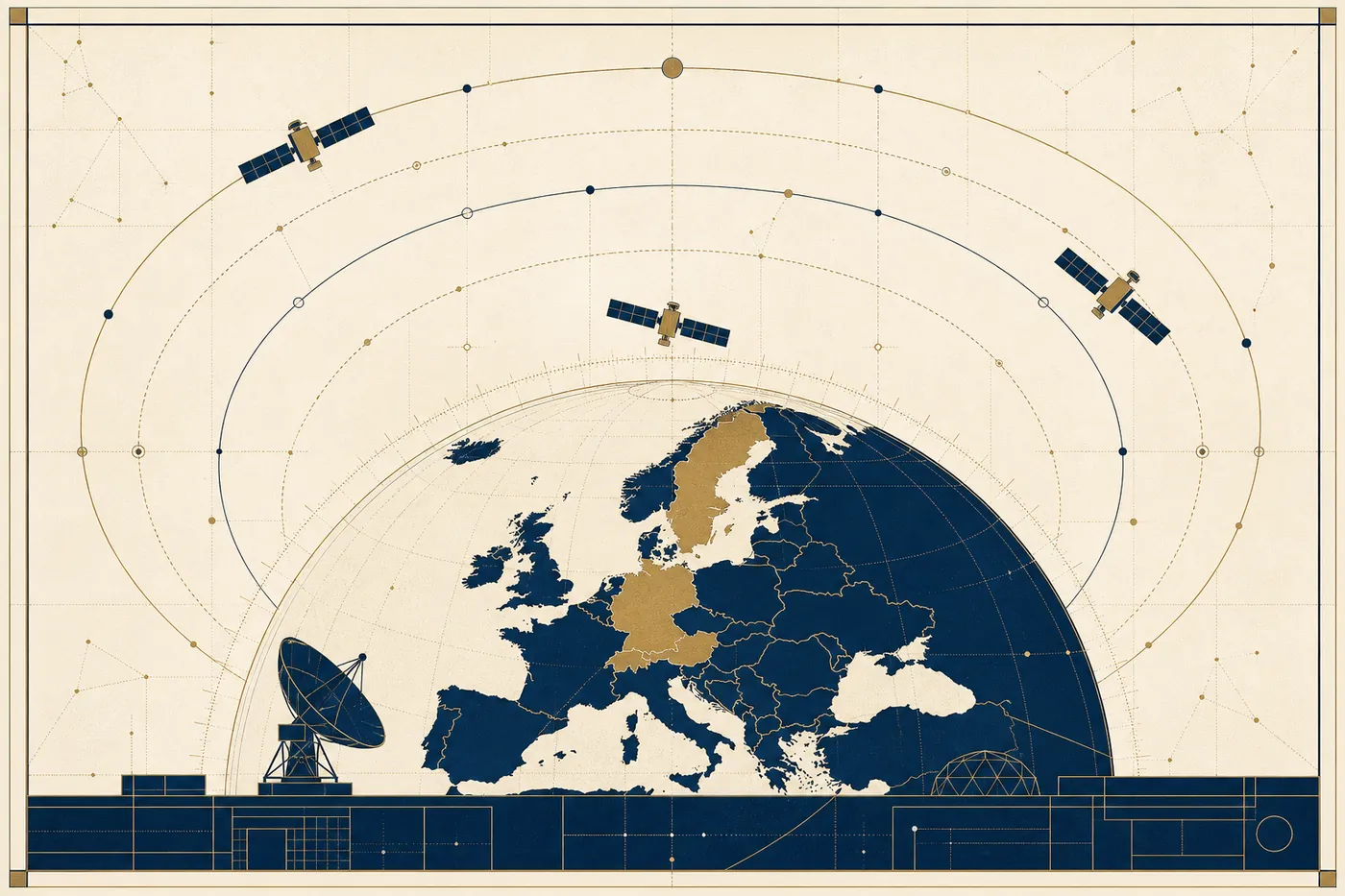
Dfensio flagged the SPACE project of common interest on 3 July 2026, when the Commission published its proposal for a Council Implementing Decision establishing European Defence Projects of Common Interest. The annex states the estimated overall financial size of the SPACE EDPCI as 'Up to EUR 24 billion by 2034' and records 'the involvement of a high number of countries (16)': Belgium, Czechia, Denmark, Germany, Ireland, Greece, Spain, France, Italy, Luxembourg, the Netherlands, Poland, Romania, Finland, Sweden and Norway. [1]
That is a published statement of intent, not a signed contract. It names seven capability areas (space-based early warning, SATCOM, ISR including SIGINT, space domain awareness, PNT and NAVWAR, responsive space systems, a multi-mission constellation) and the states that will pay for them.
Reading the ambition figure honestly
Suppliers should understand exactly what the €24 billion is. It is an indicative overall investment considered by the participants, published in a Commission factsheet and in the annex to a proposal for a Council implementing decision. [1][2][9] It is not a voted budget line, and it is not a procurement envelope. The EDIP support attached to all five projects of common interest together is €325 million, against a combined ambition of roughly €190 billion by 2036. [2]
The commercial value of the figure lies elsewhere. It tells a supplier which sixteen states have agreed to work together on which seven space capability areas, and by when. National procurement will follow that map, and national procurement is where contracts are signed.
Space and satellite programmes flagged by Dfensio
| Programme | Country | Value | Stage | Flagged by Dfensio (date) | Expected contract window |
|---|---|---|---|---|---|
| EDPCI SPACE (SBEW, SATCOM, ISR/SIGINT, SDA, PNT/NAVWAR, responsive space, multi-mission constellation) | 16 states (BE, CZ, DK, DE, IE, EL, ES, FR, IT, LU, NL, PL, RO, FI, SE, NO) | Up to €24,000,000,000 by 2034 (indicative) | Proposal for a Council Implementing Decision | 2026-07-03 | National procurements from 2026 onward |
| Joint Space capability (consolidated development) | Belgium | €616,664,033 | New contract(s), first commitment year 2026 | 2025-07-18 | 2026-2034 |
| IRIS2 secure connectivity constellation | European Union | Value not published by the Commission; 12-year concession | Concession contract signed with SpaceRISE; constellation raised to 348 satellites | 2024-12-16 | Subcontracting to 2029-2030 |
| MCMV satellite terminals upgrade | Belgium | €73,434,717 | First commitment year 2027 | 2025-07-18 | 2027-2029 |
| MUSIS / CSO optical reconnaissance and successor satellites | France with DE, BE, ES, IT, EL | No euro value published on official French sources | Successor satellites listed among 2026 orders [7] | 2025-10-31 | 2026 onward |
| G2G Enhanced Radio Frequency Constellation Simulator (G2G ERFCS) | European Commission (DG DEFIS) | €10,000,000 | Awarded to GMVIS Skysoft SA [8] | 2026-01-13 | Closed; follow-on work open |
Where an official source publishes no value, that is recorded as such. The widely quoted IRIS2 totals do not appear in the Commission's own announcement.
IRIS2: what the Commission published, and what it did not
On 16 December 2024 the European Commission announced the signature of the IRIS2 concession contract with the SpaceRISE consortium: SES, Eutelsat and Hispasat, with Thales Alenia Space, OHB, Airbus Defence and Space, Telespazio, Deutsche Telekom, Orange, Hisdesat and Thales SIX as core subcontractors. The announcement describes a 290-satellite constellation in medium and low Earth orbit, a 12-year concession, and services from 2030, with the EU as anchor customer. [4]
It contains no euro figures. The commonly cited totals originate from the concessionaire, not from the Commission. For anyone sizing an opportunity, the published fact is the industrial structure and the timeline, and the industrial structure is the actionable part, because it names the ten organisations through whose supply chains the work will be placed.
The programme has since grown. EUSPA reported on 7 August 2026 that the constellation has been raised to 348 satellites, with first launches targeted for 2029. [5] An expanded constellation on a compressed schedule is, for a component or ground-segment supplier, the most favourable configuration there is.
National lines are where the contracts sit
Belgium is the clearest published national case. Fiche Z 005, Joint space (consolidated development), is worth €616,664,033, with first commitment year 2026, settlements 2026-2034 and contracting scope 'New contract(s)'. The official description enumerates the work: strengthening the Space Security Centre; contributing to (micro-)SATCOM constellations with protected waveforms for resilient connectivity; supporting a low Earth orbit observation constellation to enhance ISR; engaging in Belgian and European projects to mitigate risks to positioning, navigation and timing systems; enhancing SATCOM anchoring and SATCOM/GNSS terminals; developing future sensors including an Antarctic telescope for monitoring satellites and debris; and joining a European project for space-based early warning against ballistic and hypersonic threats. [3] A separate line upgrades the satellite terminals of the mine countermeasures vessels at €73,434,717 from 2027. [3]
That is a supplier's target list: seven distinct procurement objects, each with its own industrial base, inside one budget line.
France runs the other end of the spectrum. The MUSIS/CSO optical reconnaissance system is operated in cooperation with Germany, Belgium, Spain, Italy and Greece, with CNES as delegated contracting authority, Airbus Defence and Space responsible for the satellite and the user ground segment, and Thales Alenia Space for the optical instrument. [6] Successor satellites are listed among the orders planned for 2026. [7] No euro value is published for these lines on official French sources.
What Dfensio flagged
- SPACE project of common interest, up to €24 billion by 2034, 16 states: flagged 3 July 2026, ahead of the national procurements that will implement it.
- Belgian Joint Space capability, €616,664,033: flagged 18 July 2025 as a new contract with first commitment year 2026, with seven named procurement objects.
- Belgian MCMV satellite terminals upgrade, €73,434,717: flagged 18 July 2025, eighteen months before the first commitment year of 2027.
- IRIS2 concession: flagged 16 December 2024 at signature with its ten-member industrial structure; enlargement to 348 satellites and first launches in 2029 flagged 7 August 2026.
- MUSIS/CSO successor satellites: flagged 31 October 2025 among France's 2026 orders.
Next steps for space and satellite suppliers
If your capability sits in payloads, optics, RF and antenna systems, protected waveforms, GNSS and PNT resilience, ground segment, launch integration, space surveillance sensors or satellite terminals, the practical sequence is: map your offer against the seven capability areas named in the SPACE project; identify the national lines with a 2026 or 2027 first commitment year; and engage the concession and prime structures, SpaceRISE for IRIS2, CNES and its primes for MUSIS, rather than waiting for a national notice.
Frequently asked questions
Is the €24 billion SPACE figure a budget or an ambition?
It is an indicative figure. The annex to the Commission's proposal for a Council Implementing Decision of 3 July 2026 states the estimated overall financial size of the SPACE project of common interest as 'up to EUR 24 billion by 2034', and the accompanying factsheet describes it as the indicative overall investment considered by the participants. It is not a voted appropriation. Its value to suppliers is that it names sixteen states, seven capability areas and a horizon.
How much is IRIS2 worth?
The European Commission's own announcement of 16 December 2024 publishes no euro figure. It confirms the signature of the concession contract with the SpaceRISE consortium, a 290-satellite constellation in medium and low Earth orbit, a 12-year concession and services from 2030. EUSPA reported in August 2026 that the constellation has been raised to 348 satellites with first launches targeted for 2029. Totals circulating in the press come from the concessionaire rather than from the institution.
Which national space programme is most open to new suppliers in 2026?
Belgium's Joint Space capability line, €616,664,033 with first commitment year 2026, classified as new contracts. It covers protected-waveform SATCOM, a low Earth orbit observation contribution, PNT resilience, SATCOM anchoring and terminals, space surveillance sensors including an Antarctic telescope, and participation in European space-based early warning. Each of those is a distinct procurement object with its own industrial base.
Which European states are committed to joint military space capability?
Sixteen are named in the SPACE project of common interest: Belgium, Czechia, Denmark, Germany, Ireland, Greece, Spain, France, Italy, Luxembourg, the Netherlands, Poland, Romania, Finland, Sweden and Norway, with the Commission participating and the High Representative and the European Defence Agency as observers. That list is the practical map of where national space procurement will be concentrated over the next decade.
Official sources
- Proposal for a Council Implementing Decision on the establishment of European Defence Projects of Common Interest, annex (SPACE project). European Commission, DG Defence Industry and Space, 2026-07-03
- Commission proposes five joint defence projects to strengthen Europe's industrial capabilities. European Commission, DG Defence Industry and Space, 2026-07-03
- Capability Investment Portfolio, Belgian Defence (fiche Z 005, Joint space consolidated development). Belgian Defence (mil.be), 2025-07-18
- Commission takes next step to deploy the IRIS2 secure satellite system (IP/24/6439). European Commission, 2024-12-16
- Commission accelerates IRIS2 deployment with enhanced security and expanded constellation. EU Agency for the Space Programme (EUSPA), 2026-08-07
- Programme MUSIS, Direction générale de l'armement. Ministère des Armées (France), DGA, 2025-01-01
- Projet de loi de finances 2026, LPM année 3. Ministère des Armées (France), 2025-10-31
- Belgium, G2G Enhanced Radio Frequency Constellation Simulator (G2G ERFCS), contract award notice 19810-2026. Tenders Electronic Daily (TED), Publications Office of the EU, 2026-01-13
- European Defence Projects of Common Interest (EDPCI) on Space, factsheet. European Commission, DG Defence Industry and Space, 2026-07-01
Dfensio's analysts are available to answer questions on any programme mentioned in this article. Request a confidential briefing at dfensio.com/contact.