Military infrastructure is Europe's most dispersed defence market
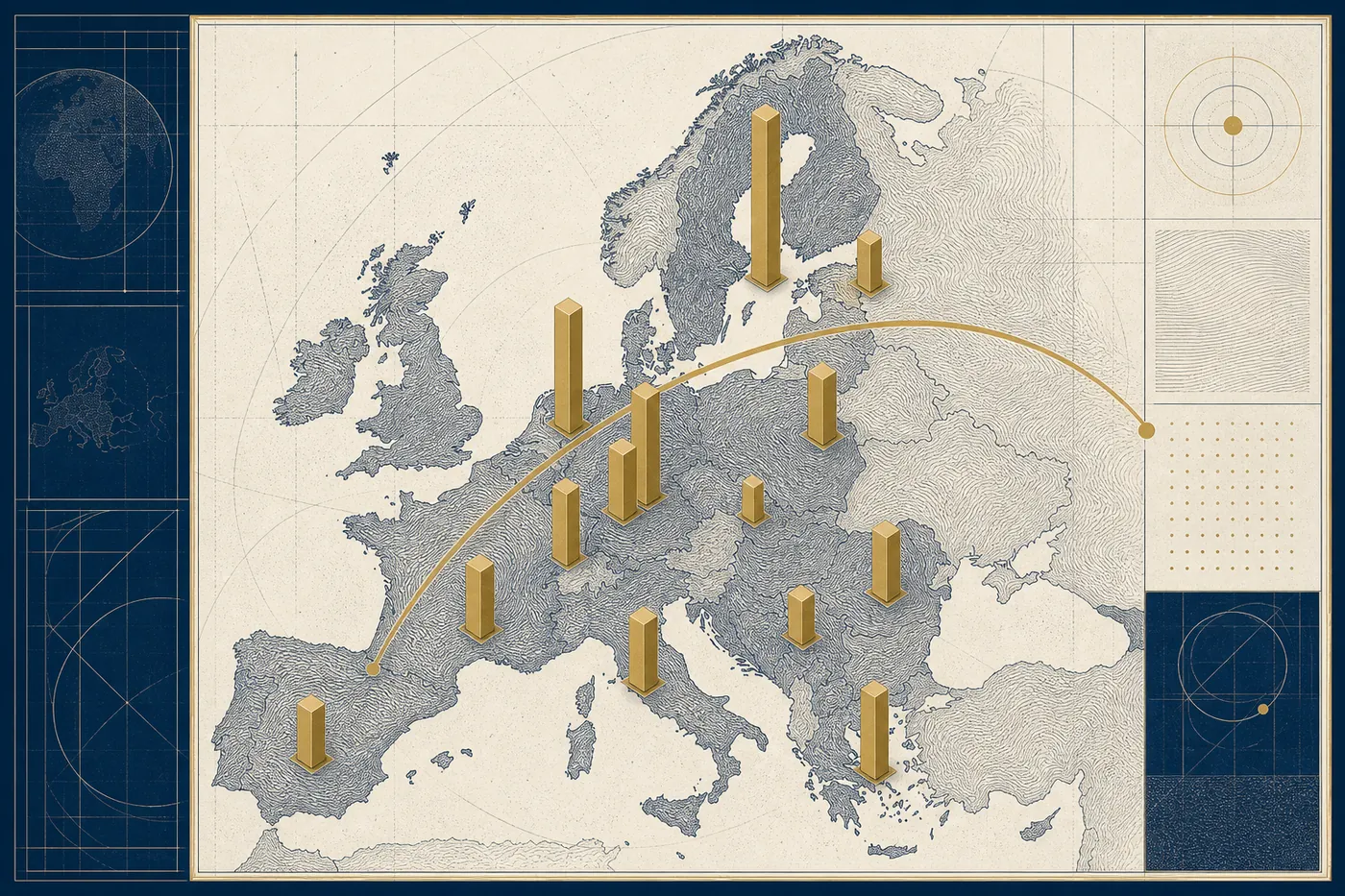
European military infrastructure procurement behaves differently from equipment procurement. Bases, depots, hangars and quays are bought by many different authorities: defence ministries, central real-estate agencies, and host nations acting for NATO. The buyers differ, the languages differ, and the deadlines are short.
The projects themselves, however, are programmed years ahead. Dfensio flagged Belgium's Joint & General Support Land domain, worth €1,535,491,187 and containing deployable field infrastructure and deployable ammunition infrastructure among its eight named line items, on 18 July 2025, roughly two years before the first commitment year of the deployable field infrastructure line itself. [3] The Belgian programme table as a whole sits under an investment ceiling of €33.784 billion in constant 2026 euros for 2026-2034. [8]
The largest live projects: Mons, the Dutch barracks framework, Zeebrugge
Three projects illustrate the scale currently on the market.
SHAPE, Mons (Casteau). On 21 February 2025 Belgium published a call for candidates for the construction of a new headquarters for Supreme Headquarters Allied Powers Europe together with infrastructure for the NATO Communications and Information Agency, with an estimated value of €610,000,000 and a deadline of 25 April 2025. [1] This is the single largest defence-related works contract advertised in Belgium in the period, and it will decompose into structural, mechanical, electrical, security and fit-out packages for years.
Standardised barracks, Netherlands. The Rijksvastgoedbedrijf, the Dutch central government real-estate agency, published a framework on 24 April 2025 for new-build standardised accommodation buildings for Defensie: around 2,000 rooms, split into two lots of €100 million, with named locations including Leeuwarden air base and the Harskamp military camp. [2] The contracting authority is the real-estate agency, not the Ministry of Defence.
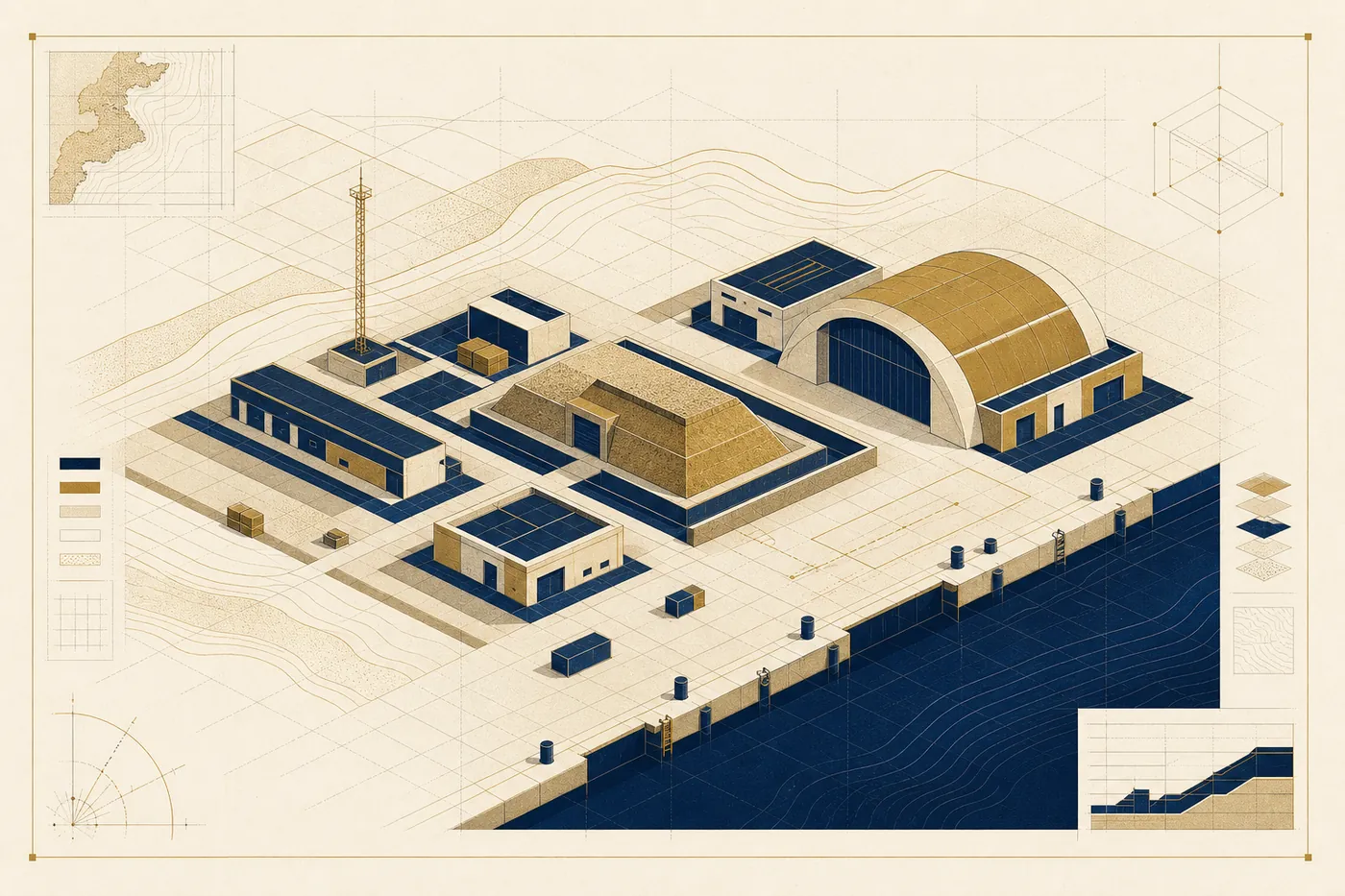
Zeebrugge naval base. Belgium is rebuilding its naval base around the rMCM mine countermeasures vessels and the anti-submarine warfare frigates. A design-build-maintain contract for a new command-and-control facility (the 'tour DEF') was advertised on 11 July 2025 with no value disclosed [9]; works for the deepening of Dock 1 and the renewal of quay infrastructure and technical systems followed on 22 June 2026, with a deadline of 26 August 2026. [6]
Military infrastructure programmes and contracts flagged by Dfensio
| Programme | Country | Value | Stage | Flagged by Dfensio (date) | Expected contract window |
|---|---|---|---|---|---|
| New SHAPE headquarters, Mons (Casteau), with NCIA infrastructure | Belgium / NATO | €610,000,000 | Call for candidates, deadline 25 April 2025 | 2025-02-21 | Works packages 2025-2030 |
| Standardised barracks buildings for Defensie (around 2,000 rooms, two lots) | Netherlands | €200,000,000 | Framework agreement | 2025-04-24 | Call-offs 2025-2029 |
| Joint & General Support Land domain (incl. deployable field and ammunition infrastructure) | Belgium | €1,535,491,187 | Programmed 2026-2034; deployable field infrastructure €178,413,237, first commitment 2027 | 2025-07-18 | 2027-2029 for the infrastructure lines |
| Zeebrugge naval base, Dock 1 deepening and quay renovation | Belgium | Not published | Contract notice, deadline 26 August 2026 | 2025-07-11 | Award expected late 2026 |
| Framework (48 months, 2026-2030) for construction of hangars across military quarters | Belgium | Not published | Contract notice, deadline 14 July 2026 | 2026-05-19 | Award 2026, call-offs to 2030 |
| Melsbroek 15W, infrastructure to operate and manoeuvre military transport aircraft | Belgium | Not published | Design-build-maintain contract | 2025-11-21 | Award expected 2026 |
| Maintenance and restoration of protective earth cover on ammunition igloos (2024-2034) | Belgium | €4,273,776.88 awarded (est. €3,450,414) | Awarded to Quintelier [4] | 2025-07-01 | Closed; call-offs to 2034 |
| Centralised weapons depot, South Complex, Bourg-Léopold | Belgium | €5,155,545.48 | Awarded [10] | 2025-03-12 | Closed |
Where a value is marked 'not published', the contracting authority did not disclose one.
Deployable infrastructure is a defence market, not a construction market
A distinction matters for suppliers deciding where to compete. Fixed infrastructure (barracks, hangars, runways, depots) is bought under works procedures from construction contractors. Deployable infrastructure is bought as equipment, under defence procedures, from a different industrial base.
Belgium's programme makes this explicit. Fiche Z 109, Modules 150 Pers, describes 'mobile, rapidly transportable facilities and equipment' including 'container based specialised shelters, command posts, lodging and force protection', each module housing 150 persons on long-term deployment; first commitment year 2027, settlements 2029-2034, contracting scope 'New contract(s)'. Fiche Z 110 covers two deployable ammunition storage infrastructure sets, 'modular, transportable, and secure' systems housed in standard shipping containers or prefabricated structures, with first commitment year 2029 and settlements 2031-2034. [3]
For a manufacturer of shelters, containerised systems, power generation, water treatment or force-protection structures, these are the accessible lines, and they are competed as equipment rather than as construction.
What SAFE changes for infrastructure suppliers
Regulation (EU) 2025/1106 establishing the Security Action for Europe lists among its eligible product categories 'critical infrastructure protection' and 'military mobility including counter-mobility', and extends eligibility to 'the development and acquisition of the related infrastructure, equipment and logistic services'. [7] Infrastructure is therefore inside the instrument, as a capability category attached to loans to Member States rather than as a construction grant line. Infrastructure demand financed by SAFE will therefore surface through national procurement, run by the Member States, rather than through an EU-level tender.
What Dfensio flagged
- Belgian Joint & General Support Land domain, €1,535,491,187, including deployable field infrastructure at €178,413,237: flagged 18 July 2025, roughly two years before the first commitment year of 2027.
- Zeebrugge naval base redevelopment: flagged 11 July 2025 with the command-and-control facility contract, eleven months before the Dock 1 deepening and quay works notice of 22 June 2026.
- SHAPE headquarters, Mons, €610,000,000: flagged 21 February 2025 at the call for candidates, with works packages expected to 2030.
- Dutch standardised barracks framework, €200,000,000: flagged 24 April 2025, with call-offs running to 2029.
- Belgian deployable ammunition storage sets (fiche Z 110): flagged 18 July 2025, four years before the first commitment year of 2029.
Next steps for construction and deployable-infrastructure suppliers
The practical sequence is: identify the national programme lines whose first commitment year falls in 2026 or 2027; establish whether the buying entity is the defence ministry or a state real-estate agency, and register with the right one; and, for deployable systems, treat the requirement as a defence equipment competition rather than a works tender.
Frequently asked questions
What is the largest military infrastructure contract currently advertised in Europe?
The new SHAPE headquarters at Mons (Casteau), together with infrastructure for the NATO Communications and Information Agency, advertised by Belgium on 21 February 2025 with an estimated value of €610,000,000. It will decompose into structural, mechanical, electrical, security and fit-out packages over several years, which makes it accessible to specialist subcontractors as well as to the main works contractor.
Who buys military infrastructure in Europe?
It varies by state. In Belgium the Ministry of Defence buys directly. In the Netherlands the Rijksvastgoedbedrijf, the central government real-estate agency, buys barracks for Defensie. NATO infrastructure can be bought by a host nation on the Alliance's behalf, as with the new SHAPE headquarters advertised by Belgium. Suppliers should register with each of these buyers rather than with defence ministries alone.
What is the difference between fixed and deployable military infrastructure?
Fixed infrastructure is construction: it is procured under works procedures from building contractors, with site-specific contracts. Deployable infrastructure is equipment: containerised shelters, command posts, accommodation modules and deployable ammunition storage sets. It is procured under defence supply procedures, often through framework agreements, from a manufacturing rather than a construction industrial base. Belgium programmes the two separately, with deployable field infrastructure at €178,413,237 and first commitment year 2027.
Does SAFE fund military infrastructure?
Yes, as a capability category. Regulation (EU) 2025/1106 lists critical infrastructure protection and military mobility including counter-mobility among eligible categories and extends eligibility to related infrastructure, equipment and logistic services. The financing is a loan to the Member State, so the resulting contracts are national procurements rather than EU-level tenders.
Official sources
- Belgium, construction of a new headquarters for SHAPE at Mons (Casteau) and infrastructure for the NCIA, call for candidates (notice 119427-2025). Tenders Electronic Daily (TED), Publications Office of the EU, 2025-02-21
- Netherlands, Raamovereenkomst nieuwbouw gestandaardiseerde legeringsgebouwen voor Defensie (notice 263943-2025). Tenders Electronic Daily (TED), Rijksvastgoedbedrijf, 2025-04-24
- Capability Investment Portfolio, Belgian Defence (249 programme fiches). Belgian Defence (mil.be), 2025-07-18
- Belgium, contrat pluriannuel (2024-2034) pour le maintien et la remise en état de la couche de terre de sécurité sur des igloos de munitions (notice 423098-2025). Tenders Electronic Daily (TED), 2025-07-01
- Belgium, meerjarige raamovereenkomst van 48 maanden (2026-2030) voor de bouw van hangars binnen de diverse kwartieren van Defensie (notice 342175-2026). Tenders Electronic Daily (TED), 2026-05-19
- Belgium, Marinebasis Zeebrugge, Dok 1: uitdieping, vernieuwing en renovatie van de kade-infrastructuur en technieken (notice 424664-2026). Tenders Electronic Daily (TED), 2026-06-22
- Council Regulation (EU) 2025/1106 establishing the Security Action for Europe (SAFE). EUR-Lex, Publications Office of the EU, 2025-05-28
- Projet de loi de programmation militaire en matière d'investissements, de personnel et de renforcement technologique pour la période 2026-2034, doc. 56K1143/001. Chambre des représentants de Belgique, 2025-11-03
- Belgium, réalisation d'une nouvelle infrastructure ('tour DEF') pour soutenir le commandement et le contrôle des chasseurs de mines et des ASWF, base navale de Zeebrugge (notice 454261-2025). Tenders Electronic Daily (TED), 2025-07-11
- Belgium, marché public ponctuel pour la construction d'un dépôt d'armes centralisé dans le Complexe Sud à Bourg-Léopold (notice 161275-2025). Tenders Electronic Daily (TED), 2025-03-12
Dfensio's analysts are available to answer questions on any programme mentioned in this article. Request a confidential briefing at dfensio.com/contact.